
Ausgewählter Ausschnitt: A hollow shaft is often cheaper to turn from tube when suitable stock already has enough wall allowance and the bore needs only modest finishing. Solid bar can be more economical or safer when the through-bore is small, the available tube is eccentric, or tight relationships between the bore and bearing journals require substantial cleanup. Compare the complete material, drilling, boring, turning, workholding, inspection, and scrap costs at the actual batch quantity.
Einführung
A hollow shaft may look like a simple cylinder with a hole through it. Yet the quote can swing sharply with a small change in bore diameter, length, wall thickness, or journal runout. An OEM buyer may receive one offer based on solid bar and deep drilling, another based on seamless tube and finish boring, and a third that assumes a secondary operation. Those offers are not comparable until the process assumptions and acceptance criteria are clear.
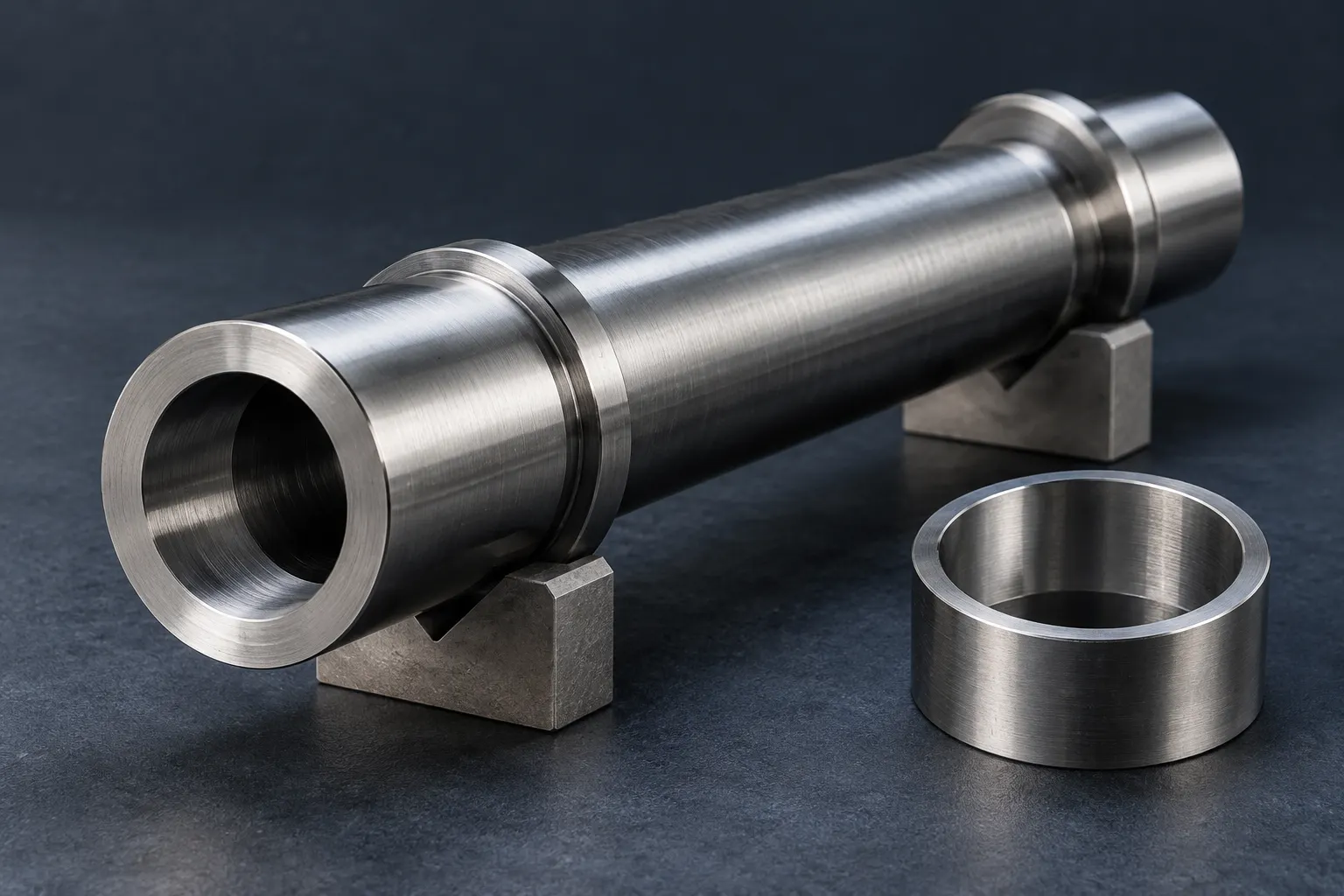
For buyers researching hollow shaft CNC turning cost, the central question is where the functional axis comes from. Does the assembly run on an external bearing journal, locate on the internal bore, or require both axes to agree? The answer determines the stock choice, setup sequence, gripping method, and measurement plan. Lauens CNC can review the CAD model and controlled drawing to identify these cost drivers before a production route is fixed.
This article focuses on a turned tubular shaft with one or more outside journals, a continuous bore, and optional shoulders or grooves. It explains what a supplier must price, which drawing decisions reduce avoidable work, and how to request a quote that exposes the important assumptions. It does not substitute a generic tolerance promise for a review of the actual geometry.
Technischer Tiefgang
First define the functional axis
鈥淐oncentric鈥?is often used casually in RFQs, but it can hide several different requirements. A bearing journal may need low total indicated runout relative to another journal. A through-bore may need a positional or coaxial relationship to those journals. The bore may only route a cable or coolant and have no precision centering role at all. These cases should not receive the same tolerance and inspection plan.
If the outside journals govern rotation, a practical process may machine them in a common setup and treat the bore as a clearance passage. If the bore carries a precision mandrel or locates a mating tube, the process may establish the bore first and finish the journals while referenced to it. If both surfaces are critical, the supplier must consider how the part is supported, whether a second gripping step changes alignment, and how the relationship is measured after release from the chuck. A shaft can meet every individual diameter and still fail its assembled runout requirement.
Choose the starting stock with the finished allowance in mind
Solid round bar provides a known exterior envelope and flexibility for shoulders, but every cubic millimeter of the central passage must be removed. For a large, long bore, drilling time and chips can dominate. Tube stock can eliminate much of that material removal. However, the purchased tube’s outside diameter, inside diameter, wall variation, straightness, alloy condition, and availability matter. A low-priced tube is not automatically a low-cost blank if finishing requires heavy cuts on both surfaces or if the wall becomes locally too thin.
For a tube route, calculate the minimum finished wall around the full circumference, not just the nominal difference between two diameters divided by two. Stock eccentricity and the amount removed to clean up the bore and journals can reduce the thinnest section. If the finished drawing controls bore-to-OD relationship tightly, a tube with generous but uneven allowance may still require substantial boring and turning. Ask the supplier whether the quote includes a defined stock specification or assumes any commercially available tube.
For a bar route, drilling is usually a roughing step, not evidence that the finished bore will be straight, round, and correctly sized. Depending on diameter, length, material, and tolerance, the bore may need subsequent boring, reaming, honing, or another finishing operation. A small-diameter long bore poses different access and chip-control problems than a large short bore. The relevant cost measure is the full bore-making route, not simply the volume removed.
| Starting route | Likely advantage | Primary risk or cost | RFQ question |
|---|---|---|---|
| Solid bar, drilled and finish bored | Flexible exterior geometry and known starting OD | Material removal, long drilling, chip control, bore finishing | What bore process and inspection are included? |
| Seamless tube, ID and OD finished | Less core material to remove when stock is suitable | Stock availability, wall variation, eccentricity, cleanup allowance | What stock ID, OD, and wall allowance are assumed? |
| Near-net tubular blank | Potentially lower cutting time at stable production volume | Blank tooling, minimum quantity, supplier lead time | When does nonrecurring blank cost pay back? |
| Two-piece assembly | May simplify a complex internal feature | Joining, alignment, qualification, and assembly validation | Is the joint permitted by the design and load case? |
A useful hollow shaft CNC turning cost comparison holds the functional drawing constant while allowing different stock and machining routes. It should explicitly state whether a seam, weld, or joined construction is prohibited. Do not let a two-piece alternative silently replace a monolithic shaft where torque, fatigue, cleanliness, or sealing requirements make that unacceptable.
Internal tool reach changes the economics
Finishing a long bore is not just a matter of adding minutes of cycle time. A boring bar must enter the hole with enough clearance for chips and coolant while remaining stiff enough to control size and finish. As overhang grows relative to bar diameter, the tool becomes more sensitive to deflection and vibration. Tool manufacturers recommend minimizing overhang and managing cutting forces and chip evacuation for this reason. A small increase in finished bore diameter may allow a stronger boring bar, but that option exists only if wall thickness and function permit it.
Long tubes can also flex under cutting forces. A steady rest, tailstock strategy, or other support may be considered according to geometry, but support contact itself can mark or deform a thin wall. Likewise, chuck force must hold the blank without squeezing it out of round. A thin tube may measure correctly while gripped and spring back to a different shape when released. Inspection after unclamping is essential for critical diameters and runout.
Sequence matters as much as the machine model
A process plan may rough the exterior, create the bore, relieve stress if required by the material and design, and finish the critical journals in a controlled relationship to the bore. Another plan may start from a finished tube ID and turn the OD from a mandrel. Neither is universally best. The choice depends on which surface locates the assembly, how much stock must be removed, and whether the gripping surfaces survive subsequent operations.
Where shoulders, threads, grooves, and cross-features are added, consider their position in the sequence. A late deep-bore operation that scraps an almost finished shaft wastes more invested machining time. On the other hand, some finishing passes must occur late to preserve the final datum relationship. A supplier’s route should balance these risks rather than merely list all possible operations.
Leitlinien zur fertigungsgerechten Konstruktion (DFM)
Identify the surfaces that actually perform work
On the drawing, distinguish the bearing journals, seal surfaces, torque features, and clearance bore. A cable-routing bore may require a smooth deburred entrance and minimum free diameter, but not a tight full-length diameter. A press-fit or fluid-sealing bore is different: its size, surface texture, and relationship to the exterior may control assembly. If only a short entrance length is functional, specify that length instead of imposing the tightest bore requirement along the entire shaft.
Use a datum structure that follows assembly. If two external journals establish rotation, define the relevant runout or axis relationship from those journals. If an internal pilot establishes location, make that bore the meaningful reference. Avoid a stack of independently tight diameters and generic 鈥渃oncentric all diameters鈥?notes. A clear functional requirement lets the process engineer decide which surfaces must be finished together and which can be made in a separate operation.
Review minimum wall at every step
Nominal wall thickness is only a starting value. Add the bore and OD tolerance limits, stock eccentricity, straightness, finishing allowance, groove depth, and any cross-hole or keyway. Check the thinnest region under worst-case material condition. A groove cut into the outside of a hollow shaft can leave a much smaller ligament than the drawing’s general wall dimension suggests. Where load, pressure, fatigue, or sealing are critical, the customer should validate the structural design; the machinist can flag manufacturability but cannot replace that analysis.
For a prototype, consider whether the bore can be modestly larger or the exterior slightly thicker without harming function. A few tenths of a millimeter may change available tooling or tube stock, but no universal threshold applies. Ask for a DFM review tied to actual blank sizes and tool access rather than guessing an arbitrary 鈥渕inimum wall鈥?rule.
Keep the bore as accessible as practical
A constant through-bore is easier to drill, clean, and inspect than a small blind cavity behind an internal shoulder. If the design needs a stepped bore, show the transition, usable depth, corner relief, and whether a drill point is allowed. Deep internal grooves are especially costly when they force a long small-diameter tool. If the bore can be machined from both ends, state whether a small meeting mismatch is functionally acceptable. That choice can shorten tool reach, but it may be inappropriate for a seal, bearing, or close-fit mandrel.
Entrance and exit edge requirements deserve attention. A sharp internal burr can cut a cable, shed debris into a fluid path, or prevent full insertion of a mating component. Specify the functional edge break and cleanliness requirement. Avoid using an unmeasurable blanket note if the critical edge is inside a long bore; explain how acceptance will be judged.
Make finishing and coating allowances explicit
If journals will be plated, coated, heat treated, or ground after turning, identify the final dimension and which process is responsible for it. A bore that must remain unobstructed after finishing may need masking or a post-finish cleaning step. The quote must cover the complete delivered condition, not just the prefinish turned geometry. If a surface finish callout applies only to a bearing journal or seal land, limit it to that area rather than the entire shaft.
Send a clean RFQ package
Supply a 3D solid, a controlled 2D drawing, material grade and condition, target quantity, delivery schedule, and end use. Mark whether the bore is clearance, a precision fit, or a fluid passage. Include the required bore-to-journal relationship, minimum wall, inspection method if mandated, and any no-weld or one-piece construction rule. Ask for separate prices at prototype and production quantities where future demand is plausible. This information saves both buyer and supplier from quoting different parts under the same drawing number.
Kostenaufschlüsselung und Wirtschaftlichkeit
In a hollow shaft CNC turning cost review, the quote should make sense as a sum of material, nonrecurring preparation, machining, secondary work, inspection, and risk. Material can be decisive for a large bore made from expensive alloy bar. For a thin precision tube, however, qualified stock may cost more than expected and may need sorting or extra cleanup. Do not assume the lighter purchased blank automatically yields a lower delivered price.
Nonrecurring preparation includes programming, first-article setup, workholding design, and measurement planning. Machine cycle includes sawing, facing, drilling or boring, turning of journals and shoulders, parting, deburring, and any transfer. A tight bore-to-OD relationship may add a mandrel, soft jaws, extra passes, or separate inspection. The cost of a specialized support arrangement is spread over the lot, so the best route can change between a ten-piece trial and a recurring production order.
| Kostentreiber | Why the price moves | Useful buyer decision |
|---|---|---|
| Blank type and availability | Bar wastes core material; tube may need qualified wall allowance | Permit the supplier to compare both stock routes |
| Bore diameter and length | Drilling, boring-bar reach, chips, and straightness risk change | Control only the functional length and diameter |
| Minimum finished wall | Thin sections increase grip distortion and finishing risk | Check structural need before reducing wall |
| ID-to-OD relationship | Shared datums, mandrels, and runout inspection may be needed | Define the assembly’s actual reference axis |
| Secondary features | Grooves, threads, cross-holes, and finishes add operations | Identify critical features and allowed alternatives |
| Order quantity | Setup and workholding costs are amortized differently | Request meaningful quantity breaks |
How to compare bar and tube quotations
Start with the delivered specification, then ask each supplier what stock it assumed. Compare gross blank cost and waste, bore-making time, ID and OD cleanup, holding method, and inspection. A tube quotation should state how stock wall variation is handled. A bar quotation should identify the route for the full-length bore and whether the tolerance is achievable with drilling alone or needs finishing. If one offer excludes deburring or final runout inspection, normalize the scope before choosing the lowest figure.
Material yield is not just the ratio of finished weight to starting weight. A heavier bar may be easier to source and hold, and a tubular blank may reduce cutting but introduce a qualification lead time. In short runs, minimum stock purchase can dominate. In larger runs, minutes saved in each bore operation can outweigh a more expensive blank. This is why blanket statements that tube is always cheaper or that bar is always more accurate are poor purchasing guidance.
What tight tolerances really buy
Some tolerances protect a real function: bearing life, seal performance, vibration, or assembly interchangeability. Others survive from a copied drawing without a clear purpose. A tight diameter on a noncontact bore adds no value if it only passes a cable, while a loose journal runout requirement could create field failures. Trace each controlled feature to its mating component and load case. Then request the least restrictive requirement that preserves performance.
Do not confuse size with relationship. A bore and journal may each pass a micrometer or bore gauge while their axes are displaced. Conversely, a shaft can have a sound axis relationship but a bore that is undersize. The RFQ should state how acceptance is established, including whether 100% measurement, first-article reporting, or sampling is required. Inspection effort belongs in the quotation, especially for long bores that are difficult to probe directly.
Scrap risk and process sequence
If a long bore breaks through an end wall, drifts outside a minimum wall envelope, or leaves a defect late in the route, the supplier may lose both blank and accumulated machining time. A robust process may use more conservative cuts, intermediate checks, or earlier bore creation. Those steps can increase visible cycle time while lowering total delivered cost by reducing rejects. Ask for a process rationale if a surprisingly cheap quote assumes an aggressive sequence with no explicit verification.
The correct economic comparison also includes revision risk. If your first prototype changes bore diameter or journal length, a flexible bar route may adapt faster than dedicated stock or tooling. When the design stabilizes and volume rises, a qualified tube or near-net blank may become attractive. Keep prototype and production routes open until the functional drawing is validated.
Fazit und Aufruf zum Handeln
Hollow shaft CNC turning cost depends on the functional axis, bore length, minimum wall, stock quality, workholding, and inspection plan far more than on the part’s simple cylindrical appearance. Solid bar and tube are competing routes, each with conditions where it wins. A clear drawing lets the supplier price the right geometry, avoid unnecessary tight controls, and protect the surfaces that determine assembly performance.
Have a hollow shaft ready for quotation? Upload your 3D CAD file and controlled drawing to Lauens CNC with material, quantity, critical journal and bore requirements, and intended use. Request a free DFM review and a quote comparing practical blank and turning routes before you commit to a production method.


