
Ausgewählter Ausschnitt: A threaded insert usually costs more to specify and install than a directly tapped hole because it adds purchased hardware, a special parent thread, installation, and verification. It may still be the lower lifecycle-cost choice when an aluminum part is repeatedly assembled, has a repair requirement, or needs a durable female thread; the right quote compares the complete hole and inspection route, not the insert price alone.
Einführung
A buyer sends two drawings for the same milled aluminum housing. One calls out eight tapped holes. The other calls out eight stainless wire-thread inserts. The geometry looks nearly identical in the CAD model, yet the second RFQ can involve different drills and taps, insert procurement, additional handling, and a distinct inspection plan. If the drawing says only “install inserts,” the supplier cannot know which hardware, length, locking behavior, or acceptance method to price.
The sourcing question is therefore broader than the price of a coil. In practice, threaded insert cost in CNC aluminum parts depends on the quantity and location of holes, the chosen insert system, wall thickness, access for the installation tool, finishing sequence, and whether the job includes insert installation or only the machined parent holes. This guide compares the routes and gives engineers a practical way to prepare an RFQ.
Lauens CNC describes CNC-Fräsen for custom parts with holes and threads. Send the actual model and drawing for a project-specific manufacturability review. Whether insert supply and installation are included should be stated explicitly in the quotation scope rather than assumed from a machining-service page.
Technischer Tiefgang
Direct tapping and insert-ready holes are different operations
With a directly tapped hole, the aluminum itself carries the female thread. The shop drills a suitable pilot hole and cuts or forms the specified thread in the parent material, then checks it against the drawing. It is often the simplest route for a low-cycle assembly with adequate engagement and a sound boss. The design still needs a real thread callout, usable depth, accessible entry, and appropriate inspection, but there is no separate insert component to buy or install.
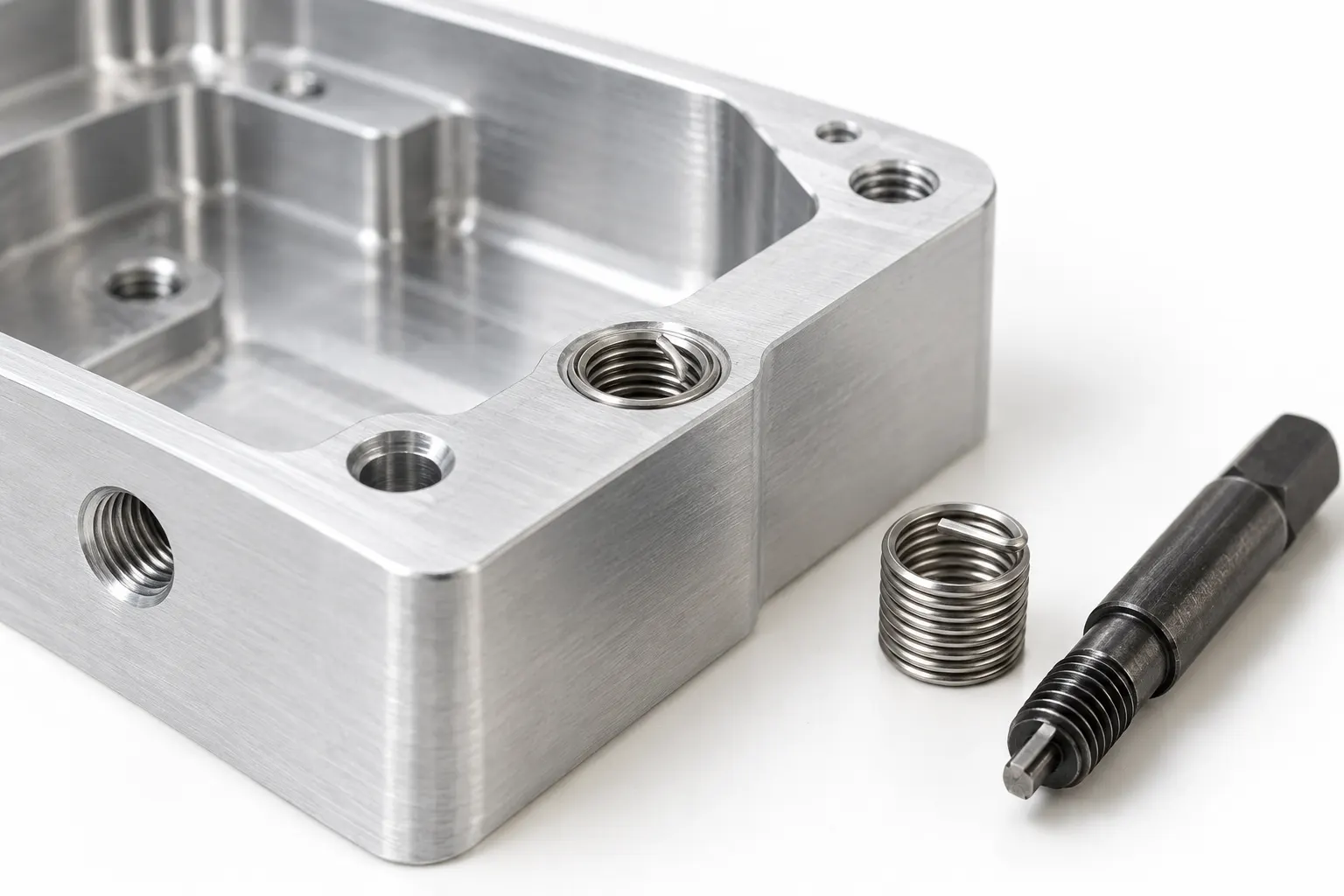
A helical wire insert uses a specially prepared parent hole. The drill size and screw-thread-insert (STI) tap are chosen for the selected insert system, not for an ordinary female thread of the final bolt size. The coil is installed into that parent thread to create the final internal thread. A tanged design may require tang removal and retrieval; a tangless design changes tooling and hardware choice. Manufacturer data should govern the hole preparation, counterbore or entry treatment if required, parent-thread class, installed depth, and gaging. Substituting a standard tap because the nominal bolt size matches would make the parent hole incorrect.
Not every threaded insert is a wire coil. Solid keyed inserts, self-tapping inserts, and other systems have their own hole and installation requirements. A drawing that names only the final screw thread leaves the manufacturing route unresolved. Specify a manufacturer part number or a controlled equivalent with the exact type, nominal thread, length, material, and locking option. If equivalents are allowed, state the performance and inspection requirements that an alternative must meet.
| Connection route | Machining and assembly steps | Typical sourcing implication |
|---|---|---|
| Directly tapped aluminum hole | Drill, tap or thread mill, deburr, inspect | Fewest components and operations when the joint’s duty permits direct aluminum threads |
| Helical wire insert, free-running | Drill to insert-system specification, STI tap, clean, install coil, verify final condition | Adds insert hardware, installation labor, and control of installed depth |
| Helical wire insert, screw-locking | Same parent-hole preparation, with system-specific locking insert and inspection | May add hardware cost and assembly considerations; use only when the locking function is required |
| Solid or keyed insert | Prepare system-specific larger hole, install and secure per supplier instructions | Can require more wall thickness, hardware cost, and dedicated installation space |
| Machined parent hole only | Shop supplies a correctly prepared and inspected housing; another party installs the insert | Lower quoted scope but transfers installation, yield, and final acceptance responsibility |
This table is a process comparison, not a promise that one option will always be cheaper. Quantity, hole access, insert size, material, testing, and who owns installation can change the result. A supplier should quote the exact route shown on the current drawing.
Strength and durability should be tied to the joint
An insert is not automatically necessary in every aluminum part. The screw size, available engagement, load direction, tightening torque, assembly frequency, and material condition determine whether the direct thread is adequate. An insert can be useful when a frequently removed fastener would wear a soft parent thread, when a repairable interface is valuable, or when a specific design standard calls for one. In a static, lightly loaded joint with sufficient engagement, adding hardware may create cost without solving a real failure mode.
Do not decide solely from generic rules such as “all aluminum threads need inserts.” An M3 sensor cover fastened once has a different duty from a service panel opened every week. Likewise, a large insert close to the edge of a thin wall may introduce more risk than a smaller direct thread in a redesigned boss. If joint strength is critical, the engineering team should validate the specific insert system, parent material, engagement, torque, and load case. A machining quote does not replace that design validation.
Finishing and inspection affect the route
Many aluminum housings are anodized or otherwise finished. The finishing sequence needs agreement because coating can alter the parent-hole fit, while installing hardware before finishing can expose the insert to process chemicals or complicate masking. There is no universal sequence suitable for every coating and insert system. The RFQ should state the finish specification, whether the parent thread is masked or processed, and whether the insert must be installed before or after finishing. The approved insert manufacturer’s instructions and the finishing supplier’s process should resolve the final route.
Inspection likewise has two distinct moments. The parent STI thread must be prepared correctly before the coil goes in. The installed insert must then sit at the specified depth and produce the intended final thread without a proud end, damaged coil, remaining tang where prohibited, or trapped debris. A GO/NO-GO check of the final thread may be useful, but it does not document every installation detail by itself. If a customer needs a traceable record, define exactly which characteristics and sampling frequency are required.
Leitlinien zur fertigungsgerechten Konstruktion (DFM)
1. Specify the complete insert, not just the screw size
Give the insert manufacturer, series, size, free-running or locking configuration, nominal length, material, and permitted alternative. A note such as “M5 insert” does not tell the shop whether to prepare a wire-insert STI hole or a larger solid-insert counterbore. The wrong assumption can scrap an otherwise finished housing. When the customer supplies inserts, define the supplied part number, packaging, acceptable substitutions, and responsibility for any shortage or defective hardware.
2. Check the boss and edge distance using the selected system
An insert-ready parent hole is larger than the final screw thread. A boss that is safe for direct tapping may not have enough remaining wall for the selected insert. Review distance to the exterior edge, pocket wall, adjacent hole, sealing land, and any internal channel. Do not apply a single generic minimum wall to every insert family. Use the supplier’s drill and tap data, then verify the residual section against the mechanical load and clamping forces expected during machining and installation.
3. Provide tool approach and a practical blind-hole depth
Insertion tools and STI taps need axial access. A deep pocket with an insert at the bottom may require a long tool or a different assembly sequence; a nearby rib can block the operator or automated tool even when the CAD thread itself looks clear. For blind holes, include space for the tap lead, thread runout, and any tang-management operation. Dimension the usable installed thread depth separately from total drill depth. If the bottom must remain sealed, call that out; a through-hole may be cheaper but unacceptable for a fluid enclosure.
4. Use a consistent hole family where possible
Eight identical inserts can share tools, setup, and verification methods. Mixing three insert sizes and two locking styles on one small part adds procurement lines, tool changes, handling risk, and inspection distinctions. Standardize where the joint duty allows it. Do not force a single size onto a heavily loaded joint merely for convenience, but ask whether minor variations reflect genuine function or historical drawing habits.
5. Protect critical faces during installation
An installer needs a stable datum and unobstructed access to each hole. If the hole sits on a precision sealing face or a cosmetic anodized panel, specify how that face must be protected from tool contact. Design a small entry relief if the chosen system permits it, and avoid placing the hole so close to a sharp pocket corner that the insertion tool cannot align. A tilted insertion can damage the first coil turn or the parent thread, creating rework after the expensive milling is already complete.
6. Decide who owns the final assembled state
The buyer may choose to receive a housing with insert-ready holes, or a housing with every insert installed and inspected. Both can be legitimate purchasing strategies, but they are different deliverables. If the machine shop is to supply the complete condition, include insert procurement, installation, tang handling, cleaning, and final verification in the RFQ. If another assembler owns installation, define the parent-hole inspection and packaging needed to preserve the holes in transit. A clean division of responsibility prevents a low machining quote from becoming an incomplete assembly.
For threaded insert cost in CNC aluminum parts, the strongest DFM action is often to mark only the joints that truly need an insert. Keeping routine low-cycle holes directly tapped can reduce operations, while retaining inserts at service-critical positions. This hybrid approach must be clearly labeled on the drawing so a shop does not mix up hole-preparation programs or install hardware in the wrong locations.
Kostenaufschlüsselung und Wirtschaftlichkeit
The hardware price is only one line
The insert itself is a purchased component, but the quotation must also cover the parent-hole machining, dedicated taps or thread mills, gages, installation tool, operator or automation time, handling, and any rejected insert or damaged housing. For a prototype with one or two inserts, setup and hardware sourcing can dominate. For a repeat production batch with many identical holes, tooling and setup are amortized, while the per-hole installation cycle, consumables, and verification dominate. Asking for quantity breaks gives the buyer a more useful comparison than a single price at a speculative annual volume.
Placement can matter as much as insert count. A top-face hole accessible in the primary milling setup is straightforward to prepare and install. A side-face hole may require another setup, indexing, or special fixture. A hole inside a narrow pocket can slow both tapping and insertion. If the part needs a precise relation between a pocket datum and insert axis, the shop may need additional inspection. Quote the actual orientation and available tool envelope rather than treating all holes as equal.
What direct tapping may save—and what it may risk
Direct tapping removes the separate hardware and installation steps. That usually lowers immediate manufacturing cost when the joint requirements allow it. It may also leave a repair risk if the fastener is repeatedly removed or over-torqued. A buyer should compare not only piece price but also assembly cycles, service cost, replacement housing cost, and the probability of thread damage in the intended application. Those inputs are design-specific; a supplier cannot infer them from a 3D file alone.
Conversely, specifying inserts everywhere does not automatically improve the design. An unnecessarily large parent hole can thin a wall, interfere with a channel, or move the centerline close to an edge. The extra hardware can complicate a finishing route and add foreign-object controls. The economic goal is not the fewest inserts or the most inserts; it is the lowest total cost that meets the joint’s validated performance requirement.
| Kostentreiber | Why it matters | What the buyer should provide |
|---|---|---|
| Insert count and variety | More installation cycles; multiple sizes require more tools and inventory lines | Hole schedule with exact insert system at each location |
| Order quantity | Setup and procurement effort are spread differently over prototypes and production lots | Realistic prototype, pilot, and repeat-order quantities |
| Parent-hole access | Deep pockets or side faces may require extra setups or long tools | 3D model showing nearby ribs, pockets, and obstructing features |
| Insert family and locking option | Hardware, tap, installation tool, and final inspection vary by system | Manufacturer part number and approved alternatives |
| Finishing sequence | Masking, handling, cleaning, or post-finish installation may add labor | Finish standard and required final assembled condition |
| Inspection and records | Parent-thread gaging, installed-depth checks, and documentation take time | Acceptance criteria and required sampling or traceability |
| Responsibility split | Machining-only prices omit insert supply and assembly risk | State whether quoted deliverable includes installed inserts |
A quote comparison should separate one-time setup or special tooling from recurring unit cost. It should also identify whether the insert hardware is included, whether every hole is installed, and whether finishing and final inspection are included. Otherwise, a lower bid may simply describe a smaller scope. A concise RFQ can request two options: a complete installed-insert part and an insert-ready machined part. That comparison shows where assembly cost sits and who will control the final quality gate.
Do not ask a shop for an instant per-hole price while leaving the insert series, quantity, and assembly scope open. A useful early estimate still needs the hole schedule and CAD geometry. If the design is not frozen, show the candidate insert system and request DFM feedback on edge distance, depth, and access before locking the drawing. An early small geometry change can prevent a late redesign or an expensive manual installation step.
Fazit und Aufruf zum Handeln
Overall, threaded insert cost in CNC aluminum parts is driven by the whole connection route: the parent hole, insert hardware, installation access, finishing, inspection, and quantity. Direct tapping is often the leanest manufacturing option when the joint duty permits it. Inserts earn their place when a durable or serviceable thread is required and the surrounding aluminum has enough material for the chosen system. The best drawing tells the supplier exactly which holes need that treatment and who delivers the final installed condition.
Upload your 3D CAD file and controlled drawing to Lauens CNC for a free DFM review and prompt quote. Include the aluminum alloy, quantity tiers, insert part numbers, finishing requirements, and whether you need inserts installed or only parent holes machined. Those details let the team evaluate your actual part and return a more useful RFQ response.


